


When Fines Replace Accountability: The NSE Settlement and the Arithmetic of Absurdity

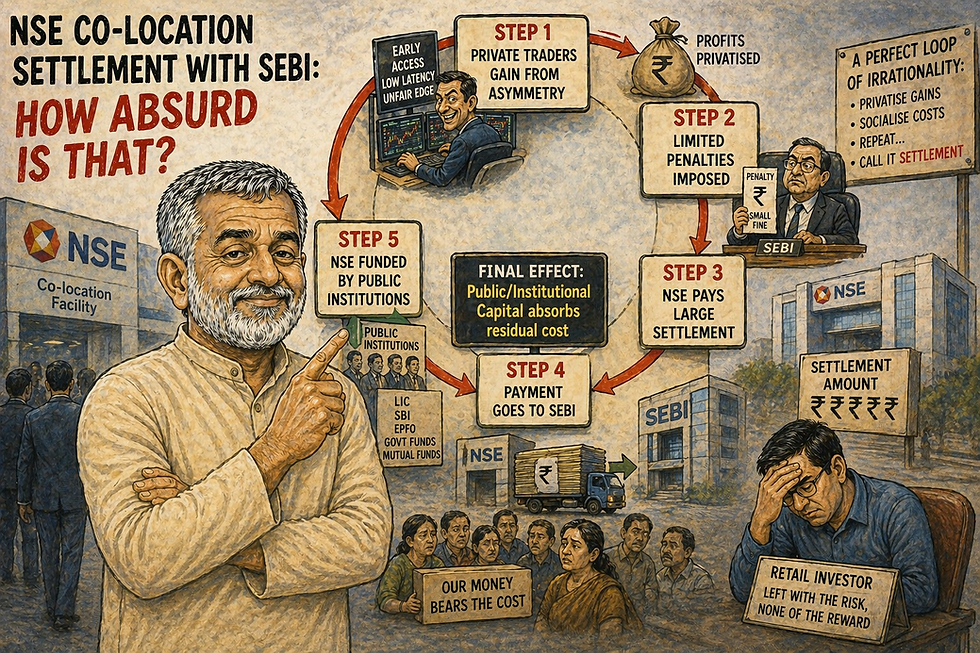
The proposed settlement between the National Stock Exchange of India (NSE) and the Securities and Exchange Board of India (SEBI) is being presented as closure. In formal terms, it fits within a consent-based enforcement architecture. In economic terms, however, it raises a sharper question:
Has a multi-year structural distortion of market fairness been reduced to a financially efficient exit?
A tighter reading—through the lenses of time horizon, beneficiary concentration, gain extraction, and penalty proportionality—suggests that the answer may be yes.
I. The Structural Period: Advantage as a Regime
Between roughly 2010–2014, the co-location architecture enabled:
Preferential access to order book data
Faster tick-by-tick feeds
Server-level login advantages
This was not episodic misconduct. It was a persistent microstructure asymmetry.
Visual 1: Nature of Advantage
Standard Market Participant        Privileged Participant
---------------------------        -----------------------
Normal latency                    ↓ Lower latency
Delayed data access               ↓ Early data visibility
Queue disadvantage               ↓ Queue priority

Outcome: Neutral market           Outcome: Systematic edge
In high-frequency markets, this translates directly into economic rent extraction.
II. Beneficiary Set: Narrow but Powerful
Regulatory focus has consistently pointed to a small cluster of high-frequency firms (single-digit to low double-digit participants).
These entities were:
Technologically sophisticated
Capital efficient
Strategically positioned
They were not incidental beneficiaries—they were optimal extractors of structural advantage.
III. Economic Extraction Model
To understand proportionality, one must first understand how gains scale.
Visual 2: Gain Mechanics
Micro Advantage per Trade (₹)  →  High Trade Volume  →  Multi-Year Duration
           ↓                            ↓                       ↓
     Small Edge                  Thousands/day           4–5 years
                                      ↓
                             Compounded Gains
                                      ↓
                         ₹100s of crores (plausible)
Even conservative assumptions yield large cumulative gains per participant.
IV. Penalty Structure: Finite vs Compounding
Observed enforcement outcomes:
Aggregate penalties → Hundreds of crores
Individual penalties → ₹1–30 crore range (typical cases)
Visual 3: Asymmetry
GAINS (Dynamic)                 PENALTIES (Static)
-----------------               -------------------
Compounding                     One-time
Market-linked                   Regulator-defined
Multi-year                      Single event
Uncapped                        Capped

Result: Gains >> Penalties
V. The Deterrence Test (Fails Quietly)
A basic enforcement condition:
Expected Penalty ≥ Expected Gain
In this case:
If:   Gain (₹200–500 Cr)  >  Penalty (₹5–20 Cr)
Then: Violation remains economically rational
This transforms enforcement into post-facto pricing, not deterrence.
VI. The Institutional Pivot
After participant-level penalties, the system arrives at:
👉 NSE paying a large settlement to SEBI
This is where the economic logic fractures.
VII. Ownership Reality: Who Actually Pays?
The NSE’s shareholding includes:
Life Insurance Corporation of India
State Bank of India
Stock Holding Corporation of India
This implies:
A meaningful portion of NSE capital is publicly anchored
VIII. The Circular Flow of Accountability
Visual 4: The Full Loop
Step 1: Private Traders gain from asymmetry
                ↓
Step 2: Limited penalties imposed
                ↓
Step 3: NSE pays large settlement
                ↓
Step 4: Payment goes to SEBI
                ↓
Step 5: NSE funded by public institutions

FINAL EFFECT:
Public/Institutional Capital absorbs residual cost
Interpretation
Private gains → partially penalized
Residual burden → socialized via NSE
State → receives payment from state-linked capital
This is not just irony. It is circular enforcement economics.
IX. The IPO Overlay
Settlement timing aligns with NSE’s long-delayed listing ambitions.
Visual 5: Incentive Alignment
Pending Cases → Settlement Payment → Clean Balance Sheet → IPO Readiness
This raises a difficult question:
Is the objective enforcement completeness—or transaction readiness?
X. Conceptual Shift: From Prohibition to Pricing
When:
Gains are not fully clawed back
Penalties are not binding
Institutions absorb residual costs
The system implicitly moves from:
“Do not violate”
        ↓
“If you do, this is the cost”
This is a first-order moral hazard.
XI. What a Coherent Framework Would Require
Visual 6: Ideal vs Observed
IDEAL SYSTEM                  OBSERVED SYSTEM
--------------               ----------------
Full disgorgement            Partial penalties
Individual accountability    Institutional settlement
Gain-linked penalties        Fixed fines
Deterrence                   Pricing mechanism
XII. Final Synthesis: The Arithmetic Doesn’t Close
The NSE settlement delivers closure—but not equilibrium.
The imbalance:
Extraction → Multi-year, compounding, private
Penalty → Finite, capped, partial
Final Cost → Institutional, diffuse, partly public
Closing Line
The issue is not that a fine is being paid.It is that:
The gains were private, the penalties were limited, and the closure is being funded—at least in part—by public capital.
That is not merely a regulatory outcome.It is a misalignment of economic accountability—precisely in the institution tasked with ensuring market fairness.

Comments