


Political Analysis or Political Theatre?How Modern Indian Politics Increasingly Looks Like a Negotiated Marketplace: Bengal, TMC, Congress and BJP

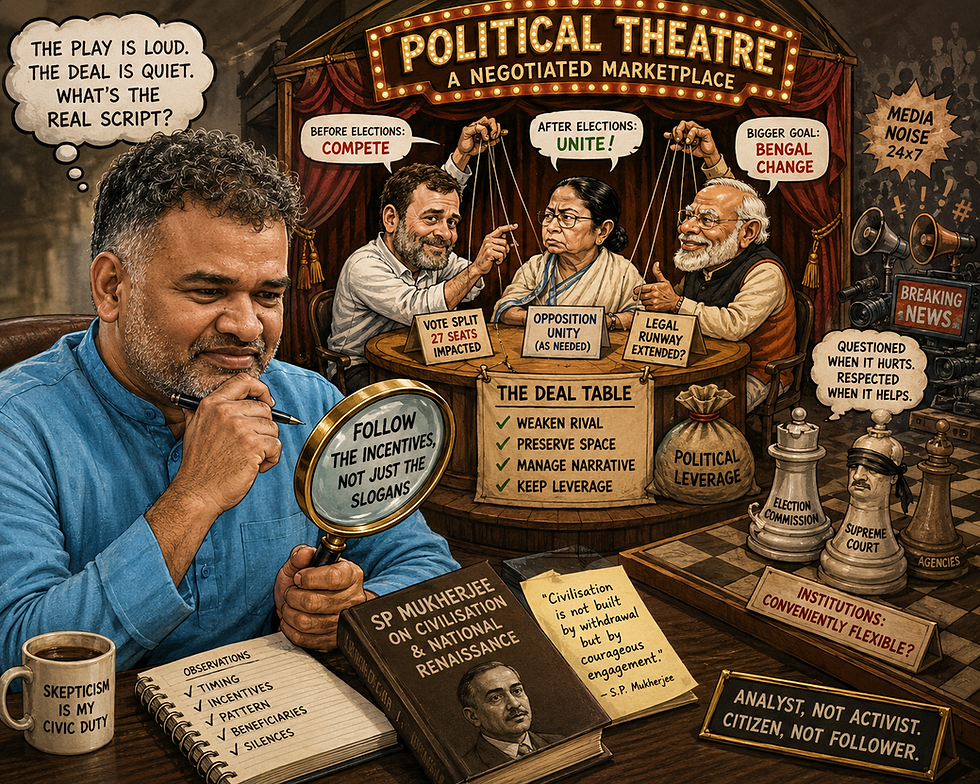
Indian politics increasingly resembles less of an ideological battlefield and more of a sophisticated negotiation table — one where conflict is real, but so are incentives, trade-offs, and strategic accommodations.
The recent dynamics involving All India Trinamool Congress, Indian National Congress, Mamata Banerjee and the Bharatiya Janata Party invite one such alternative interpretation.
To be clear, this is not an assertion of fact. It is a political theory — an attempt to interpret seemingly contradictory political behaviour through the lens of incentives and long-term strategy.
Because intelligent political actors usually understand one thing exceptionally well: survival often depends not on ideological purity, but on calibrated trade-offs.
1. The Theory
The sequence of events appears politically puzzling at first glance.
Before and during the election campaign, Congress leaders including Rahul Gandhi aggressively attacked Mamata Banerjee and the TMC ecosystem. Congress did not behave like a cooperative ally on the ground. In fact, one of the widely discussed electoral data points was that in nearly 27 assembly constituencies, TMC allegedly lost because Congress candidates split portions of the anti-BJP vote.
Ordinarily, this should have deepened hostility between Congress and TMC.
Yet post-results, the tone appeared to change dramatically.
Congress leaders suddenly became far more defensive of Mamata Banerjee while simultaneously casting doubts on institutions such as the Election Commission of India and, indirectly at times, even broader institutional neutrality.
To many observers, this looked contradictory.
But what if it was not contradictory at all?
What if every political actor involved was pursuing a different primary objective?
Under this alternative theory, the BJP leadership may have viewed political change in West Bengal as more important — even civilisationally significant — than immediately and aggressively pursuing every corruption or legal case involving Congress leadership.
For the BJP ecosystem, Bengal carries weight beyond electoral arithmetic. The ideological roots of the broader nationalist movement have deep historical links with Bengal through figures such as Syama Prasad Mukherjee. Bengal is not merely another state politically; it is often viewed as a symbolic frontier in a larger ideological and cultural project.
If such thinking exists, then weakening Mamata Banerjee’s dominance may have been considered strategically more valuable than short-term legal escalation against Congress leaders.
Under this framework:
Congress attacks TMC before elections,
opposition votes fragment,
Mamata Banerjee weakens,
BJP gains strategically,
and post-election the opposition reunifies under a larger anti-BJP narrative.
The apparent contradiction disappears once one assumes that all players understand incentives and long-term bargaining.
Politics begins resembling a calibrated ecosystem rather than a moral battlefield.
2. What Is In It for Each Actor?
The interesting part of this theory is that every major player potentially gains something.
BJP’s Potential Objective
If BJP strategists concluded that Bengal represented a long-term ideological frontier, then tactical flexibility elsewhere becomes understandable.
Political organisations, much like corporations, often prioritise flagship objectives over immediate recoveries elsewhere. Companies routinely defer aggressive action if a larger strategic acquisition is at stake.
Similarly, BJP may calculate that:
weakening TMC structurally,
expanding ideological legitimacy in Bengal,
and reducing Mamata Banerjee’s dominance
are more important than rushing legal closure in politically sensitive cases involving Congress leadership.
After all, unresolved pressure can sometimes create more leverage than decisive closure.
Congress’ Potential Objective
The Congress party is politically weakened electorally, but institutionally experienced. It has survived splits, scandals, defeats, emergencies, and ideological collapses over decades.
To assume it does not understand strategic trade-offs would be naive.
Under this theory, Congress potentially achieves multiple things simultaneously:
preserves its independent identity in Bengal by attacking TMC,
weakens Mamata Banerjee enough to regain future negotiating space,
and possibly receives extended political and legal breathing room.
This is where the theory becomes uncomfortable but politically fascinating.
Many high-profile cases involving opposition leaders in India have stretched for years without decisive closure. That naturally creates speculation that legal pressure itself may sometimes function as a political negotiating instrument.
Not necessarily through explicit conspiracy — but through mutual understanding of incentives.
In such a framework, perpetual vulnerability becomes useful leverage.
TMC’s Position
Ironically, TMC may become the biggest immediate loser in this arrangement.
If opposition votes fragmented meaningfully, Mamata Banerjee absorbs the electoral damage despite remaining part of the broader opposition ecosystem nationally.
Yet post-results, Congress once again rallies around TMC under anti-BJP messaging because preserving the larger opposition ecosystem remains politically necessary.
This creates the strange spectacle Indian voters increasingly witness:
rivals during elections,
allies after elections,
institutional critics after defeat,
institutional defenders after victory.
Why Institutions Enter the Debate
One of the most revealing aspects of modern Indian politics is how quickly institutions become central to political narratives after electoral outcomes.
The Election Commission of India, courts, investigative agencies, and constitutional bodies increasingly become arenas of political messaging.
Critics argue this weakens democratic trust.
Supporters argue institutional scrutiny is essential in democracy.
But under this alternative theory, institutional criticism also serves another purpose:it maintains political pressure while preserving opposition cohesion.
Conflict must remain emotionally intense enough for supporters.
But not so irreversible that future cooperation becomes impossible.
3. Conclusion
Perhaps this theory is entirely wrong.
Perhaps these are simply ordinary contradictions of coalition politics in a noisy democracy.
But it is becoming increasingly difficult to ignore that modern Indian politics often behaves less like a principled ideological war and more like a continuously negotiated marketplace of incentives.
Publicly:
parties attack each other,
accuse institutions,
mobilise outrage,
and project existential conflict.
Privately — or strategically — the incentives may be far more layered.
The voter therefore confronts an uncomfortable possibility:that political actors may not always seek total destruction of opponents. Sometimes they may prefer calibrated weakness, prolonged leverage, and managed rivalry.
Because permanent uncertainty can itself become a political asset.
The long-term danger, however, is significant.
If citizens begin believing that:
corruption cases are negotiable,
alliances are purely transactional,
and institutions are selectively respected,
then democratic trust gradually erodes.
Victories begin appearing manipulated.Defeats begin appearing negotiated.Politics begins resembling theatre.
And yet, perhaps the most fascinating aspect of all this is not whether the theory is true.
It is that in today’s India, such a theory no longer sounds impossible to large sections of politically aware citizens.


Comments